I’ve been running for more than 40 years, and during that time I’ve dealt with my fair share of injuries. Stress fractures, a torn meniscus, calf strains and the usual aches and pains that come with running thousands of miles.
But nothing quite prepared me for the frustration of proximal hamstring tendinopathy.
What started as a relatively minor niggle in November 2025 turned into four months of discomfort, interrupted training and countless attempts to find a solution. There were days when I wondered whether I’d ever be able to run normally again.
Thankfully, with the help of Peak Tri Performance and Dr. Eileen Compty, things eventually started moving in the right direction.
Here’s how it all unfolded.
When Things Started Going Wrong
My running had been going particularly well during the second half of 2025.
I’d enjoyed a solid summer of training, gradually increasing my long runs from 12 miles in August to 20 miles by the end of September. I was also racing well, recording a 1:23:36 at the Crawlin’ Crab Half Marathon in early October and following that up with a fun 39:32 at the Wicked 10K later in the month.
I was feeling fit, strong and optimistic about my running.
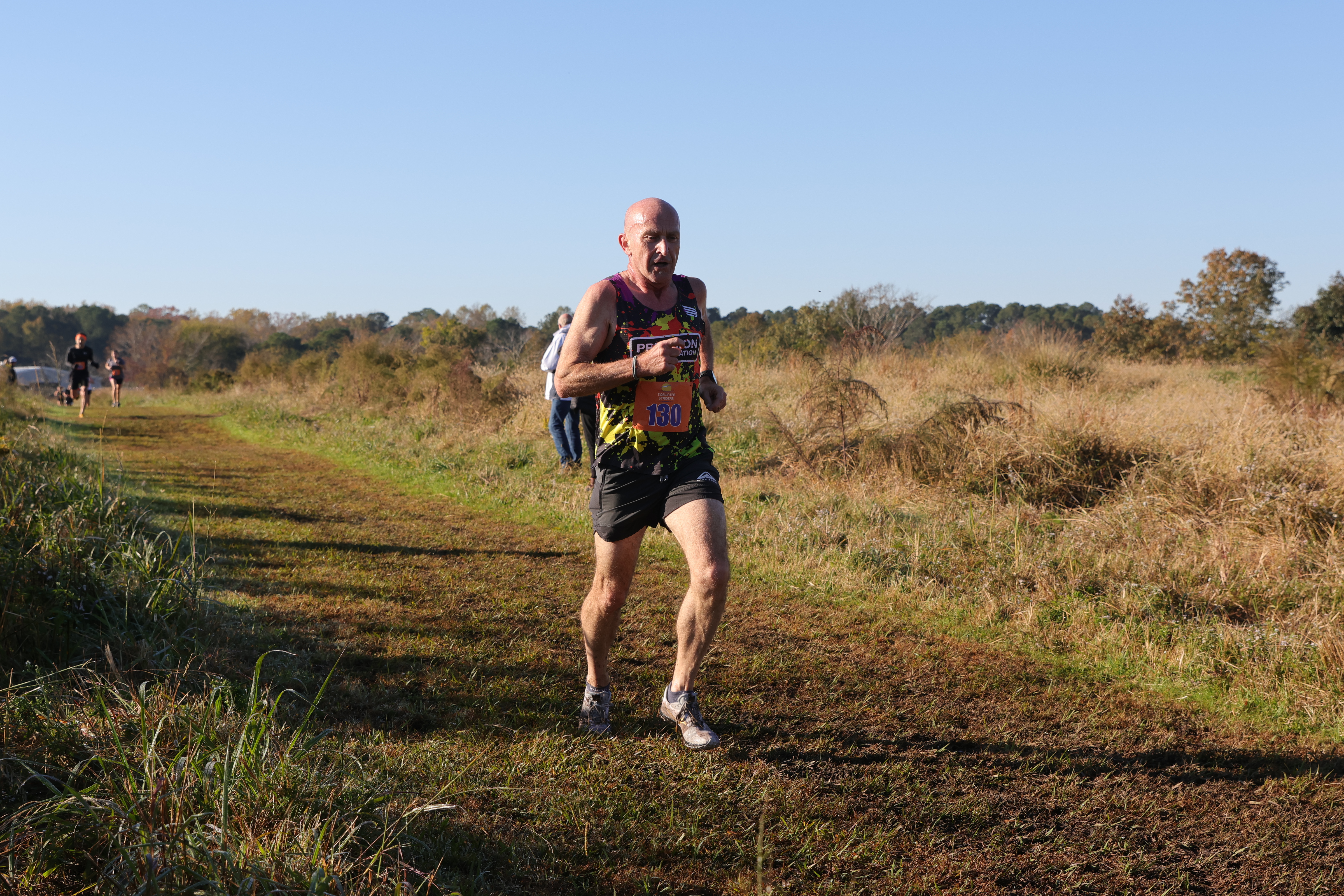
Then came the Striders Cross Country 5K on November 2.
I’d already noticed some hamstring discomfort going into the race, although it wasn’t bad enough to stop me lining up. The course was muddy, which probably didn’t help matters.
I can’t remember one particular moment when something went wrong. There was no sudden sharp pain or obvious injury during the race. But the hamstring certainly didn’t feel good afterward.
In fact, the discomfort was bad enough that I made the difficult decision to defer my Richmond Marathon entry until November 2026.
Initially, I’d hoped the problem would settle down with a little rest and some easier running. I’ve had plenty of running niggles over the years, and most have improved without too much trouble.
This one was different.
Instead of improving, the discomfort became increasingly persistent. Running felt awkward, my stride became shorter and I found myself constantly thinking about the hamstring rather than enjoying the run.
And it wasn’t just running.
Sitting at my desk, driving, walking the dog, working in the yard and even bending down to put my shoes on became uncomfortable.
For someone who’s used to being active every day, it was incredibly frustrating.
Trying Everything to Fix It
By December, I’d realized this wasn’t something I could simply run off.
I visited a local physical therapist, primarily because I was concerned I’d torn my hamstring. Thankfully, he didn’t believe that was the case and prescribed a series of strengthening and rehabilitation exercises.
They helped a little, and I even managed to complete a local 50K trail race in mid-December — extending my streak to 17 consecutive Seashore 50Ks.
But the problem wasn’t going away.
Throughout January and February, I tried just about everything I could find. YouTube videos, articles, books, social media advice, different stretching routines and strengthening exercises.
You name it, I probably tried it.
Some things seemed to help temporarily. Others made very little difference. I’d have a decent run and convince myself I was finally turning the corner, only to wake up the following morning feeling as uncomfortable as ever.
It became a seemingly endless cycle of hope and disappointment.
I contacted my local PT again, but his suggestion of attending two or three appointments each week for an indefinite period wasn’t particularly appealing. The office was a 30-minute drive from home, so each appointment would involve a fair chunk of my day.
I also spoke with a couple of online physical therapists. One was considerably more expensive than I wanted to spend, while the other seemed to offer a fairly generic approach that didn’t really address my particular circumstances.
By this point, I was getting pretty desperate.
Discovering Peak Tri Performance
I came across Peak Tri Performance on Instagram almost by accident.
I started following some of their content, which seemed particularly relevant to runners and endurance athletes, and eventually sent a direct message explaining my situation.
Within about 10 or 15 minutes, I was chatting with Dr. Eileen Compty.
We had a really positive conversation, and she arranged a virtual assessment for the following day.
That initial video consultation made a big difference.
Eileen listened to my concerns, asked about my running history and goals, and explained how she thought a structured rehabilitation program could help.
What impressed me most was that she seemed to understand how important running was to me.
I’d been fortunate enough to run at least one sub-3:00 marathon every year since 2005, and I desperately wanted to continue that streak.
One of the other virtual PTs I’d spoken to had been fairly dismissive of that goal, suggesting it wasn’t important to my long-term recovery.
Eileen took a different approach.
She understood why it mattered, supported the ambition and was realistic about what might be achievable while recovering from the injury.
There were no promises of a miracle cure or guaranteed race performances. Just a sensible plan, a commitment to making progress and an understanding that I wanted to keep running if possible.
After four months of struggling, that was exactly what I needed.
Starting the 12-Week Program
I signed up for a personalized 12-week rehabilitation program in February 2026.
Everything was delivered through an online platform and phone app, with Eileen updating my exercises each week based on how I was progressing.
The program included several different components:
- A pre-run activation routine
- A post-run recovery routine
- A pre-bike routine for my Peloton sessions
- Dedicated hamstring strengthening sessions
- Core, hip mobility and balance exercises
Initially, the exercises were relatively straightforward. Glute bridges, isometric hamstring holds, resistance-band walks and various core movements.
That doesn’t mean they were necessarily easy!
It quickly became apparent that although I was reasonably fit from years of running, there were plenty of weaknesses and imbalances that needed attention.
One of the biggest advantages was being able to complete everything at home, fitting the sessions around my running, work and other commitments.
No driving to appointments. No waiting rooms. Just open the app, follow the routine and get on with it.
And whenever I had a question, Eileen was only a message away.
The First Sign of Progress
One of my favorite memories from the entire program happened during the very first week.
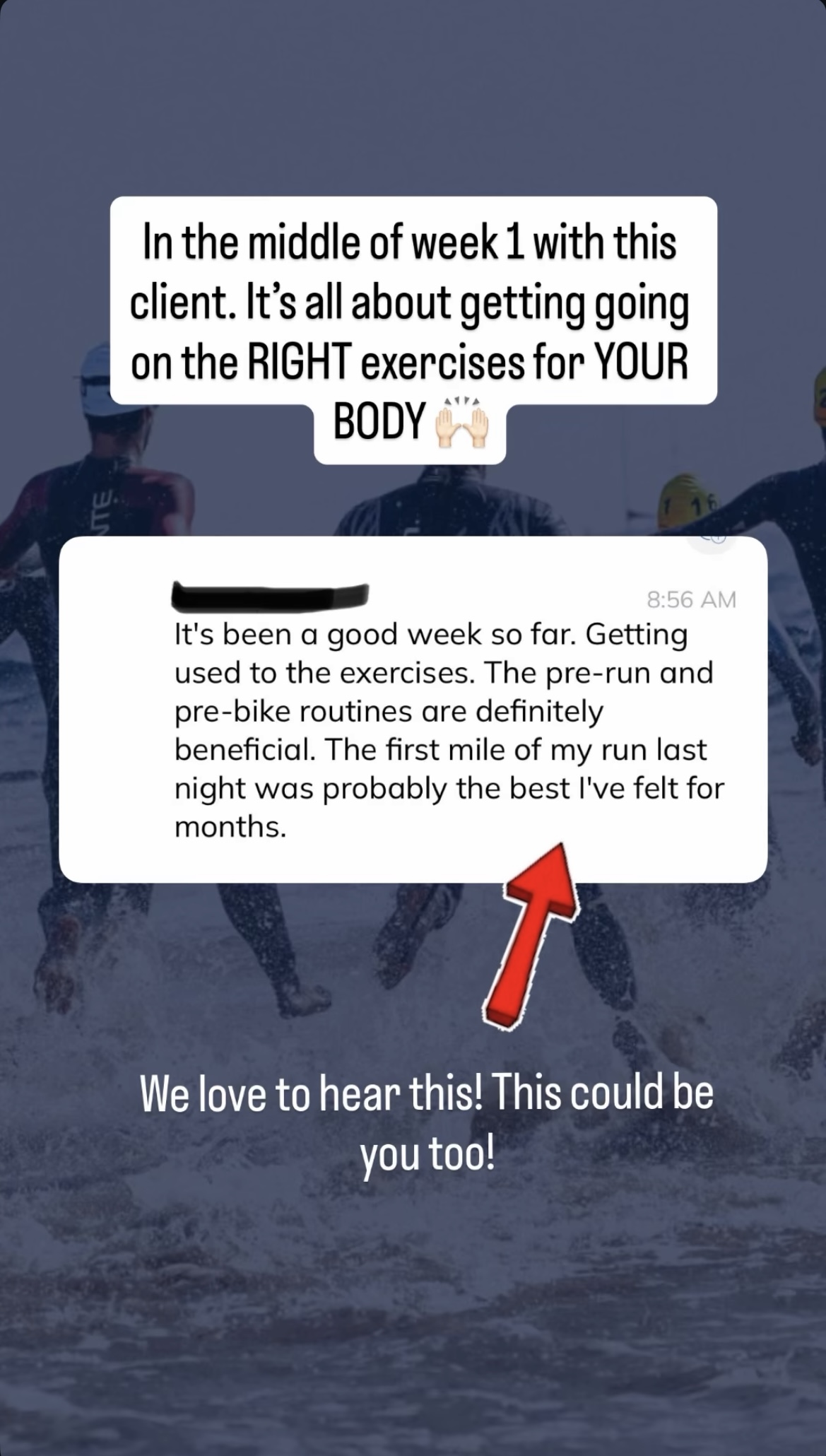
On February 26, I messaged Eileen after a run:
“The first mile of my run last night was probably the best I’ve felt for months.”
It might not sound particularly exciting, but after spending so long struggling with discomfort, that first mile felt like a huge breakthrough.
For the first time in ages, I felt genuinely optimistic that things might improve.
Of course, I wasn’t suddenly cured.
There were still uncomfortable runs, periods of soreness and days when I wondered whether I was making any progress at all.
But that early improvement gave me confidence in the program and, perhaps more importantly, the motivation to stick with it.
Getting Stronger, Week by Week
As the weeks progressed, Eileen gradually increased the difficulty of the exercises.
The early glute bridges evolved into single-leg variations, eccentric hamstring work and hip thrusters.
We added Copenhagen exercises, offset marching, single-leg power bridges, pistol squats and increasingly challenging core exercises.
Some were definitely more enjoyable than others.
The side planks, in particular, became something of an ongoing battle. I think Eileen was determined that I’d eventually master them!
One thing I appreciated was that the program never felt like a generic set of exercises.
If something was too difficult, Eileen suggested an alternative. If an exercise became easier, she’d increase the challenge. If I reported discomfort, we’d discuss it and adjust accordingly.
There was a clear progression, but never any pressure to rush through it.
By the middle of March, I was noticing some encouraging changes.
My stride was beginning to feel longer and more natural. The sharp, stabbing sensation I’d experienced in the upper hamstring was gradually becoming more of a dull ache.
And running was becoming enjoyable again.
On March 21, I reported my best run since starting the program, with significantly less discomfort than in previous weeks.
Things were finally starting to click into place.
Learning to Manage the Injury
One of the most useful things I learned was that rehabilitation isn’t always a straight line.
I’d have several good runs followed by one that felt a little uncomfortable. Some mornings I’d wake up feeling fantastic, while others reminded me that there was still work to do.
Eileen was excellent at putting those fluctuations into perspective.
Rather than focusing on whether every individual run was pain-free, we looked at the overall trend.
Was I getting stronger? Was the discomfort becoming less frequent? Was I recovering better? Could I tolerate gradually increasing workloads?
As long as things continued moving in the right direction, there was no reason to panic about the occasional difficult day.
I also made a fairly simple change to my working environment.
I spend a lot of time at my computer, and sitting for extended periods was particularly uncomfortable. In March, I switched to a standing desk, which made a noticeable difference to how my upper hamstring felt throughout the day.
It didn’t fix the injury, but it certainly helped reduce one of the things that seemed to aggravate it.
Another challenge was learning to stop thinking about the hamstring during every run.
After months of discomfort, I’d become almost obsessed with monitoring how it felt. Every little twinge would have me wondering whether I was making things worse.
As the rehabilitation progressed and running became more comfortable, I gradually started trusting my body again.
That was a big part of the recovery too.
The Best Part? I Could Keep Running
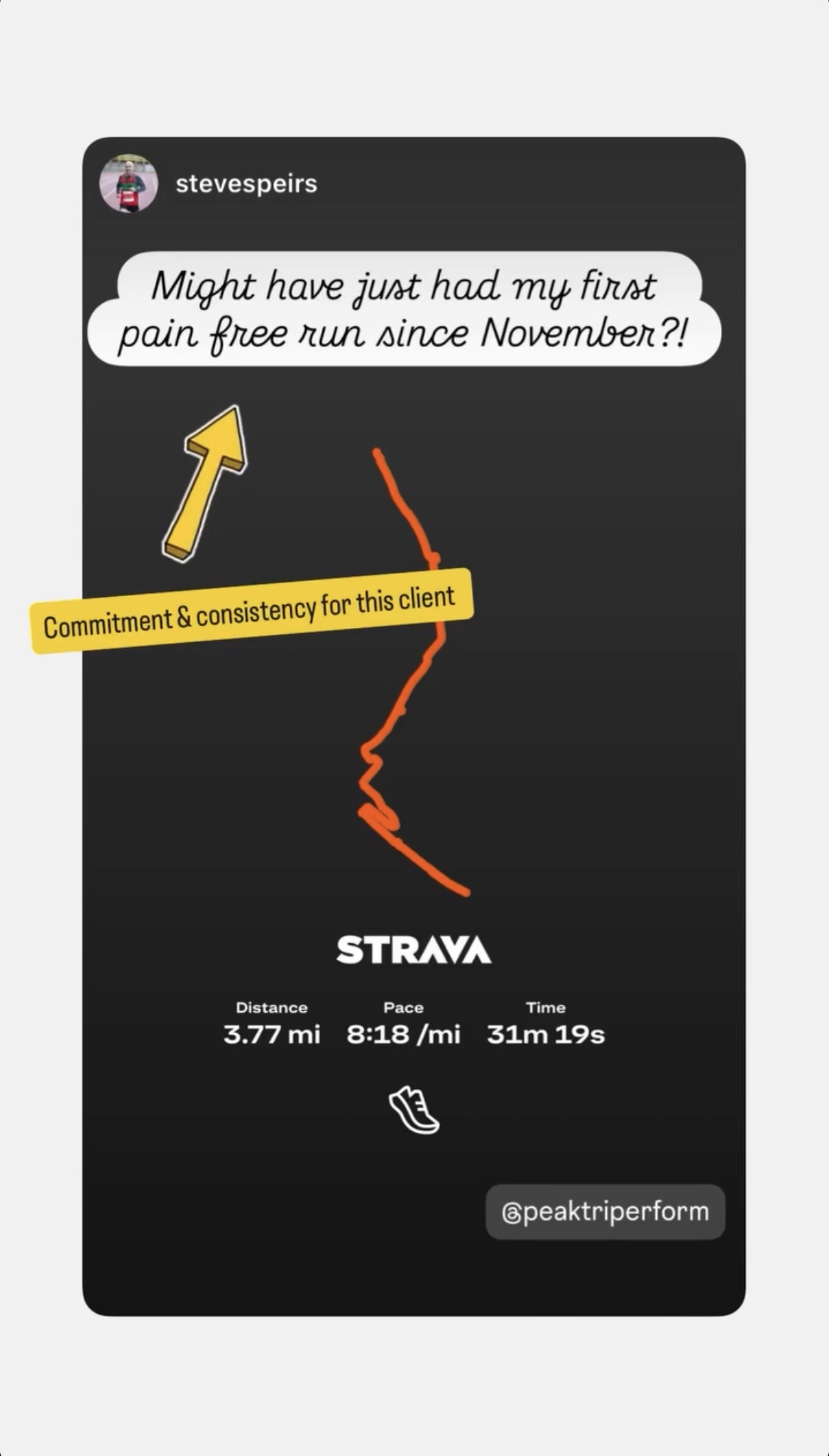
This was probably the biggest benefit of working with Eileen.
She didn’t insist that I stop running completely.
Instead, we monitored how the hamstring responded and adjusted things when necessary.
I was able to continue building my endurance, albeit with considerably less mileage than I’d normally run during marathon training.
By late March, I’d completed a 17-mile long run that included two 4.5-mile blocks close to marathon pace.
The following weekend, I managed 19 miles.
A week later, I completed another 20-mile run with minimal discomfort around the tendon.
Considering how I felt when I started the program, this was tremendous progress.
Eileen explained that if my symptoms had been getting worse, or if we’d stopped making progress, we would have needed to reconsider how much running I was doing.
But because I was improving and tolerating the workload, continuing to run made sense for my particular situation.
That balance between rehabilitation and maintaining my running fitness was incredibly important to me.
Running a Marathon Nine Weeks Into Rehabilitation
I’d originally hoped to run another sub-3:00 marathon in the spring.
As race day approached, however, it became clear that my fitness wasn’t quite where it needed to be.
My weekly mileage had averaged only around 35 miles, considerably less than I’d normally run when preparing for a marathon, and I hadn’t completed as much marathon-pace training as I’d have liked.
Still, I was healthy enough to give it a go.
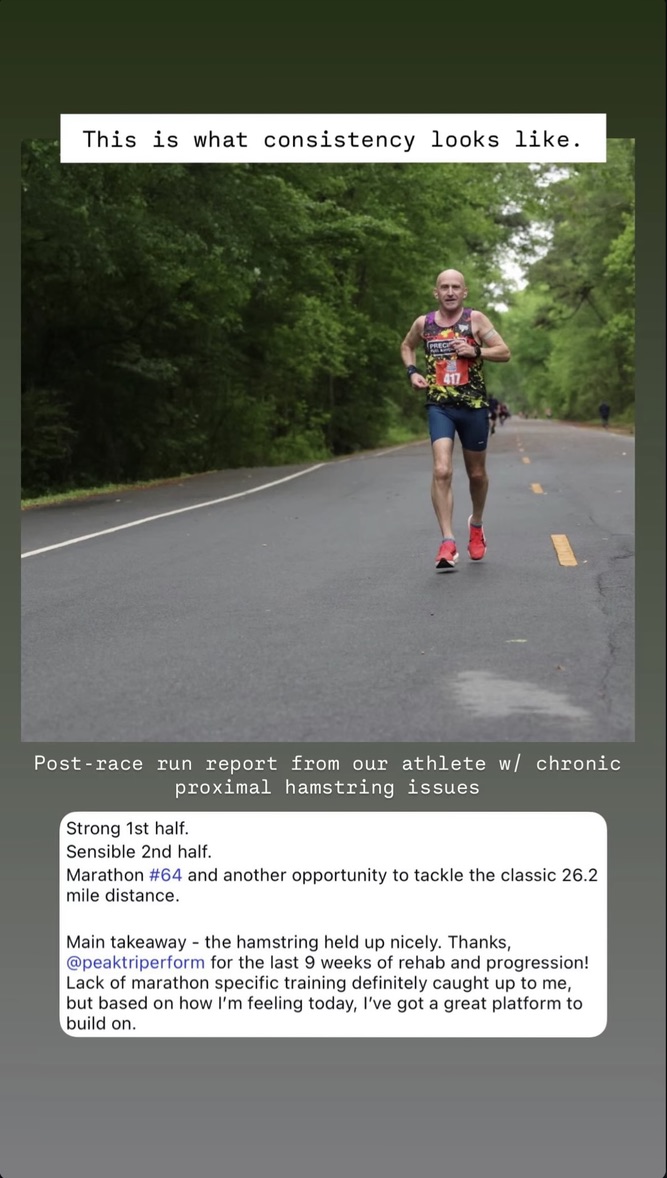
On April 26, I lined up for the marathon, unfortunately carrying a head cold and sore throat that had developed during race week.
Not ideal!
I reached halfway in approximately 1:30, but knew fairly early on that breaking three hours wasn’t going to happen.
Rather than forcing the pace, I backed off and concentrated on enjoying the second half as much as possible.
I eventually finished in just under 3:10.
Ordinarily, I’d have been disappointed to miss my sub-3 target.
This time, I was delighted.
Nine weeks earlier, I’d been struggling to run comfortably. Now I’d completed a marathon, and my hamstring had held up remarkably well.
That was a much bigger achievement than any particular finishing time.
Finishing the Program
After the marathon, we continued working through the remaining weeks of rehabilitation.
I developed a minor issue around the opposite hip, which appeared to involve the tensor fasciae latae (TFL). Eileen adjusted the program to accommodate the discomfort, and things gradually settled down.
We also started introducing more demanding hinging exercises, including kickstand deadlifts and hip airplanes.
By early May, I was reporting that my hamstring felt strong.
What a difference from February.
The 12-week program concluded in May, and we arranged a final video call to review my progress and discuss how to maintain the improvements.
I’d gone from wondering whether I’d ever run comfortably again to looking forward to another proper marathon training cycle.
What About Virtual Physical Therapy?
Before signing up with PTP, I’d only ever worked with physical therapists in person.
I wasn’t entirely sure what to expect from a virtual service.
Obviously, there are limitations. A physical therapist working remotely can’t physically examine an area, assess tissue tenderness by touch or manually move a joint in the same way they can during an in-person appointment.
That may be an important consideration depending on the injury.
But for my particular circumstances, the virtual approach worked extremely well.
The convenience was fantastic. I could complete my exercises whenever they fitted into my schedule, without spending an hour driving to and from appointments.
And the communication was probably better than I’d experienced with traditional physical therapy.
Eileen regularly checked in to see how things were going. I’d send updates after runs, ask questions about exercises or mention anything that didn’t feel quite right.
She was consistently responsive, including evenings, weekends and even while travelling in the UK.
Another thing I really appreciated was Eileen’s involvement outside the PTP app. I’d occasionally share updates about my running on Instagram, and she’d often respond with a comment, some encouragement or even share my progress on the Peak Tri Performance account.
It might seem like a small thing, but after months of struggling with the injury, having someone acknowledge those little victories meant a lot. It also reinforced the feeling that Eileen was genuinely invested in my recovery, rather than simply sending me another week’s worth of exercises.
Continuing the Work
One thing I didn’t want to do was finish the 12-week program, put the exercises away and forget everything I’d learned.
I still had access to the routines through the PTP app, and I made a point of continuing with the strengthening work.
My initial goal was to complete a couple of 20–30-minute sessions each week, alongside the pre-run and post-run routines that had become part of my regular training.
In August, I contacted Eileen again because I wanted access to the earlier weeks of the program while travelling to the UK.
She quickly reorganized everything in the app so I could work through the routines again.
It was another nice example of the support I’d received throughout the process.
The biggest lesson for me was that rehabilitation shouldn’t necessarily end the moment the pain disappears.
Maintaining strength and continuing to load the hamstrings appropriately is something I want to incorporate into my training going forward.
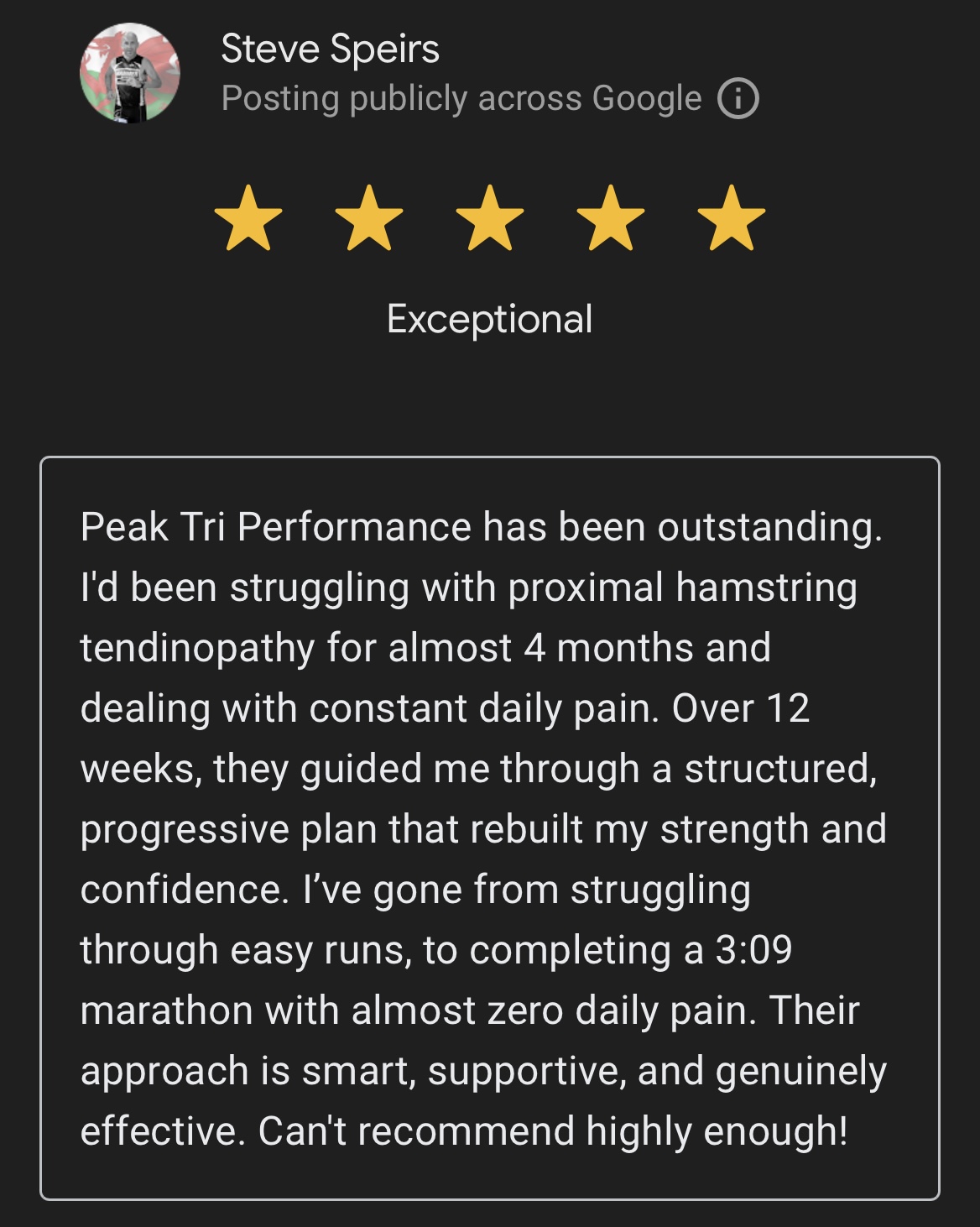
Would I Recommend Peak Tri Performance?
Absolutely.
I don’t say that because the program was easy, or because I suddenly became pain-free overnight.
It took patience, consistency and plenty of hard work.
There were frustrating days along the way, and at times I wondered whether I’d ever get back to feeling completely normal.
But I always felt that Eileen understood what I was trying to achieve and had a plan to help me get there.
Her knowledge, encouragement, communication and willingness to adapt the program made an enormous difference.
Most importantly, she helped me regain confidence in my running.
After more than four decades in the sport, I’ve learned that injuries are sometimes unavoidable. What matters is how we respond to them.
For me, working with Peak Tri Performance was one of the best decisions I made during a particularly difficult few months.
And while I certainly hope I never have to deal with proximal hamstring tendinopathy again, I feel much better equipped to look after my hamstrings in the future.
Thanks to Eileen and everyone at Peak Tri Performance for helping me get back on track.
Peak Tri Performance
Interested in learning more about the personalized rehabilitation program that helped me get back to running? Visit Peak Tri Performance to explore their approach to working with runners and endurance athletes.
This article describes my personal experience of rehabilitation for proximal hamstring tendinopathy. Every injury is different, and what worked for me may not be appropriate for everyone. If you’re dealing with persistent pain, seek advice from a qualified healthcare professional.